
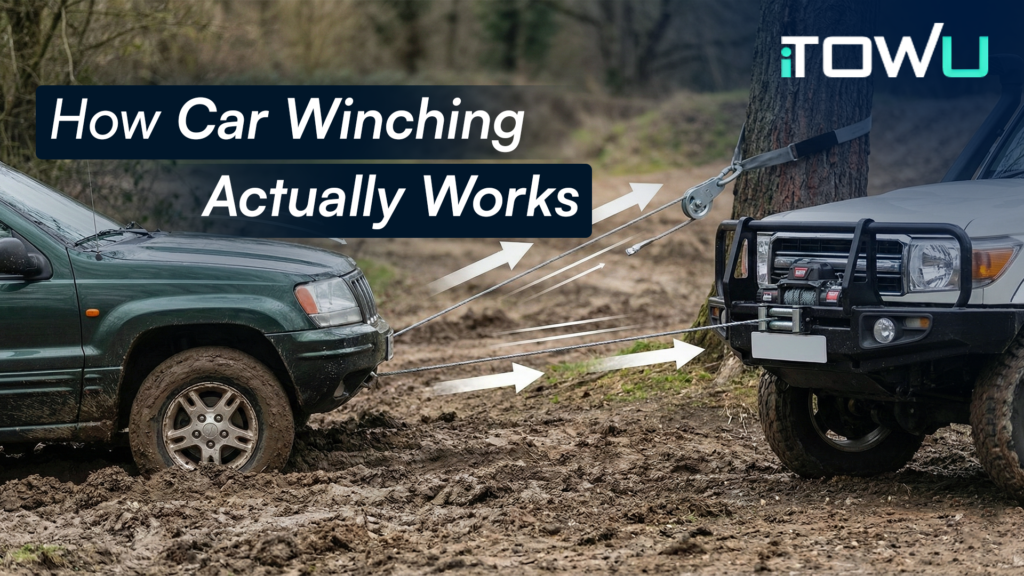
It often starts with a simple thought: “I think I can make it.” You push forward, but the wheels begin to spin, the smell of burning rubber fills the air, and your vehicle slowly sinks deeper into mud, sand, or snow. When a car is truly stuck, and gravity is working against it, a standard tow strap usually isn’t enough. This is when car winching becomes necessary.
What is Car Winching and When Do You Need It?
At its simplest, winching is the process of pulling a vehicle out of a stuck position using a motorized cable system. Winching applies controlled mechanical force to recover vehicles. A car winch is typically mounted on a recovery truck or off-road vehicle and consists of a heavy-duty cable powered by a strong winch motor.
You need winching when a vehicle is completely immobile. This is different from a car that won’t start but can still roll freely. You usually need a winching service when:
- Your vehicle is stuck in deep mud, sand, or heavy snow
- The car has slid into a ditch or down an embankment
- You’re stuck on a steep incline where a standard tow truck lacks traction
- The vehicle is positioned so the wheels cannot rotate, such as being high-centered on a rock or curb
How Does Car Winching Work and What You Need
A winch operation is about precision, not just hooking up a cable and pulling. If it’s handled the wrong way, you risk snapping the line or even bending the vehicle’s frame. That is why experts stick to controlled winching techniques to make sure the recovery is done safely and the right way.
Winching Equipment Used in Vehicle Recovery
A professional winching setup typically includes:
High-rated winch
You need a winch that has a high load rating, often capable of pulling at least 1.5 times the vehicle’s weight. This means if the weight of the car that needs winching is 6000lbs, then the winch added to the rescue vehicle should be rated to pull at least 9000lbs. This is commonly known as the 1.5× rule. However, many professionals prefer a 2× rating for added safety and control. The winch is able to achieve this feat because of the winch motor, which could be an electric motor or a hydraulic motor.
Steel cable or synthetic rope
You need strong cables that are able to pull the stuck vehicle. For winching, steel cables are highly durable and perform well around rocks and rough terrain. Synthetic ropes are also a good alternative. They’re much lighter and easier to work with. Plus, they’re a lot safer, and if one happens to break, it won’t snap back with the same dangerous force as a steel cable.
Additional equipments
- D-rings: Used to connect the winch line to recovery points securely.
- Snatch blocks: These are used to increase pulling capacity and improve control during complicated recoveries.
- Tree savers: They are protective straps that are used when anchoring to a natural object like a tree.
How Car Winching Works
- Finding an Anchor: The operator identifies a solid anchor point, such as the recovery truck itself or a sturdy tree.
- The Hookup: The winch cable is securely attached to the vehicle’s designated recovery points on the frame. It is never connected to a bumper or axle, as those parts can fail under load.
- The Pull: The winch motor slowly reels in the cable while the operator controls line speed to keep the vehicle moving straight and stable.
- Clearing the Obstacle: Once the tires regain solid ground, the winch continues assisting until the vehicle can move safely under its own power.
What to Look Out For?
Safety is critical during any winching operation. Anyone nearby should stand well clear of the winch cable in case it snaps under tension.
The general rule of thumb is that the safest distance is 1.5 to 2 times the length of the winch line. As for where exactly to stand, the best would be for you to take cover if possible, or there is the 90-degree rule. It is where you stand at a 90-degree angle to the winch line. Also, if not mentioned earlier, no one should be stuck inside the vehicle during a high-tension pull unless absolutely necessary for steering.
Quick Note: Winching is something you should leave to the professionals, especially if the situation is really serious. In such an emergency, it is important to get connected to a car winching service as soon as possible. And the best way to do that is by using the iTOWu roadside assistance app. This app will connect you with the nearest winching professionals, and they will be dispatched to your location ASAP.
Car Winching vs. Towing: What’s the Difference?
Many drivers sometimes assume winching and towing to be the same thing. But they are not the same, and they serve very different purposes. The choice between car winching and vehicle towing depends on whether your wheels can move and where your vehicle is positioned. Below is the table that correctly shows the difference between the two.
| Difference | Car Winching | Vehicle Towing |
|---|---|---|
| Primary Goal | Extracting a vehicle from an obstacle (mud, ditch, snow) | Transporting a vehicle from one location to another |
| Equipment Used | Motorized winch, cables, snatch blocks | Tow truck, flatbed, or tow bar |
| Vehicle Condition | Stuck, buried, or off-road | Rolls freely, but shouldn’t be driven |
| Direction of Pull | Often vertical or angled | Parallel to the road |
| Distance Covered | Short distance until solid ground is reached | Long distance, usually miles to a repair shop |
| Risk Level | Higher due to cable tension | Moderate under normal road conditions |
| Common Use Cases | Off-road recovery and ditch rescues | Breakdowns, accidents, and disabled vehicles |
Final Check
Getting stuck can feel embarrassing, but it doesn’t have to turn into a disaster. So, if you ever unexpectedly slide into a ditch during bad weather or get stuck in a really muddy field, a proper car winch will get you out. It’s the right solution for situations where traction is gone, and a simple tow won’t work.
Trying to “gun it” out of mud or snow usually makes things worse and can lead to costly transmission or tire damage. When the situation is beyond your control, don’t risk it. Just get help, like from the iTOWu app.